Tuesday, August 18, 2009

The Glory of Christ by John Owen

In typical Puritan fashion, The Glory of Christ by John Owen is a bold statement that spiritual life without Christ is really no spiritual life at all. If your soul feels dry and lacks any substantial joy - grab this little book (which is anything but little in content) and meditate on the greatness of God our Savior.

Quote from the book:
"A constant view of the glory of Christ will revive our souls and cause our spiritual lives to flourish and thrive. Our souls will be revived by the transforming power with which beholding Christ is always accompanied. This is what transforms us daily into the likeness of Christ. So let us live in constant contemplation of the glory of Chirst, and power will then flow from him to us, healing all our declensions, renewing a right spirit in us and enabling us to abound in all the duties that God requires of us.

Faith will fix our souls in Christ who will fill us with delight and satisfaction. This then, in heaven, is perfect blessedness, for it is caused by the eternal vision of the glory of God in Christ. So the more we behold the glory of Christ by faith now, the more spiritual and the more heavenly will be the state of our souls.

The reason why the spiritual life is our souls decays and withers is because we fill our minds full of other things, and these things weaken the power of grace. But when the mind is filled with thoughts of Christ and his glory, these things will be expelled (see Col. 3:1-5, Eph. 5:8)

Additional Resources
Discussion Questions for a 7-week discussion on the book (1, 2, 3, 4, 5, 6, and 7)

Monday, June 1, 2009

"Sin" and its power: George Hebert

Lord, with what care hast thou begirt us round!
Parents first season us: then schoolmasters
Deliver us to laws; they send us bound
To rules of reason, holy messengers,
Pulpits and Sundays, sorrow dogging sin,
Afflictions sorted, anguish of all sizes
Fine nets and stratagems to catch us in,
Bibles laid open, millions of surprise,
Blessings beforehand, ties of gratefulness,
The sound of glory ringing in our ears:
Without, our shame; within, our consciences;
Angels and grace, eternal hopes and fears.
Yet all these fences and their whole array
One cunning bosom-sin blows quite away.
George Hebert (1593-1633)

Thursday, May 14, 2009

The Reformed Pastor by Richard Baxter

Baxter's classic rebuke of pastors is convicting in the Puritan tradition and Chesterton-ian in its quotability (I had to stop taking notes). I amazed at the ability of the Puritans to convict by exposing sin specifically and, at the same time, point to the supreme glory of Christ. It is an ability that can come only from a God-entranced view of all things (to steal a title).

Below is a collection of quotes by category:

The Weighty Charge of Pastoral Ministry
"When we have led them to the living waters, if we muddy it by our filthy lives, we may lose our labour, and they be never the better." (Chapter 2 "The Oversight of the Flock" pg. 87)

"...but when we have undertaken a particular charge, we have restrained the exercise of our gifts so specifically to that congregation, that we must allow others no more than it can spare of our time and help, except where the public good requireth it..." (Chapter 2 "The Oversight of the Flock" pg. 88)

"When we are commanded to take heed to all the flock, it is plainly implied, that flocks must ordinarily be no greater than we are capable of overseeing, or 'taking heed to.' God will not lay upon us natural impossibilities: he will not bind men to leap up to the moon, to touch the stars, or to number the sands of the sea. If the pastoral office consists of overseeing all the flock, then surely the number of souls under the care of each pastor must not be greater than he is able to take such heed as is here required." (Chapter 2 "The Oversight of the Flock" pg. 88)

Work as to the Lord
Although the following quote is written with my vocation in mind, it is applicable to all as every vocation is from God and to be attended with the same vision (Col. 3:23-24). I believe all our pursuits will have an enduring quality only when motivated by a love for our Creator.
"Content not yourselves with being in a state of grace, but be also careful that your graces are kept in vigorous and lively exercise, and that you preach to yourselves the sermons which you study, before you preach them to others. If you did this for your own sakes, it would not be lost labour; but I am speaking to you upon the public account, that you would do it for the sake of the Church, When your minds are in a holy, heavenly frame, your people are likely to partake of the fruits of it. Your prayers, and praises, and doctrine will be sweet and heavenly to them. They will likely feel when you have been much with God: that which is most on your hearts, is like to be most in their ears. I confess I must speak it by lamentable experience, that I publish to my flock the distempers of my own soul. When I let my heart grow could, my preaching is cold; and when it is confused, my preaching is confused; and so I can oft observe also in the best of my hearers, that when I have grown cold in preaching, they have grown cold too; and the next prayers which I have heard from them have been too like my preaching. We are the nurses of Christ's little ones. If we forbear taking food ourselves, we shall famish them; it will soon be visible in their leanness, and dull discharge of their several duties. If we let our love decline, we are not like to raise up theirs. If we abate our holy care and fear, it will appear in our preaching: if the matter show it not, the manner will. If we feed on unwholesome food, either errors or fruitless controversies, our hearers are like to fare the worse for it. Whereas, if we abound in faith, and love, and zeal, how would it overflow to the refreshing of our congregations, and how would it appear in the increase of the same graces in them! O brethren, watch therefore over your own hearts: keep out lusts and passions, and worldly inclinations; keep up the life of faith, and love, and zeal: be much and home, and be much with God - if you make not this a work to which you constantly attend, all will go wrong, and you will starve your hearers; or, if you have an affected fervency, you cannot expect a blessing to attend it from on high." (pg 61-62)
Abide in me, and I in you. As the branch cannot bear fruit by itself, unless it abides in the vine, neither can you, unless you abide in me. I am the vine; you are the branches. Whoever abides in me and I in him, he it is that bears much fruit, for apart from me you can do nothing. (John 15.4-6)

Friday, April 10, 2009

Good Friday, a poem by Christina Rossetti

Am I a stone, and not a sheep,
That I can stand, O Christ, beneath Thy cross,
To number drop by drop Thy blood's slow loss,
And yet not weep?

Not so those women loved
Who with exceeding grief lamented Thee;
Not so fallen Peter weeping bitterly;
Not so the thief was moved;

Not so the Sun and Moon
Which hid their faces in a starless sky,
A horror of great darkness at broad noon--
I, only I.

Yet give not o'er,
But seek Thy sheep, true Shepherd of the flock;
Greater than Moses, turn and look once more
And smite a rock.

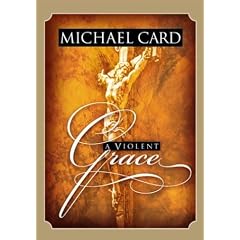
A Violent Grace by Michael Card

by canceling the record of debt that stood against us with its legal demands. This he set aside, nailing it to the cross. (Colossians 2.14)

For in him all the fullness of God was pleased to dwell, and through him to reconcile to himself all things, whether on earth or in heaven, making peace by the blood of his cross. (Colossians 1.19-20)


From Chapter 10 "He Was Nailed to the Cross So I Might Escape Judgment"
The mock trials are over.  The little that Pilate was willing to do to release Jesus, he has done. Now, for the record, he publicly washes his hands of the matter, as if the water could cleanse him of his responsibility. And then he utters the formal sentence: "Ab in crucem." You shall mount the cross. 

Four soldiers carry out Jesus' execution. Although as many as six hundred men were sent to arrest Jesus, Pilate now sees little chance of a riot. Of all Jesus' supporters, only weeping women are left.

Two soldiers lift the forty-pound crossbeam onto Jesus' shoulders. He is going to carry His own cross to the place of execution.  
...
Step by excruciating step, Jesus stumbles out of the Praetorium and down the twisted streets of the city, a great throng following.  How far does He stagger before He falls face down and lies skinned and bruised beneath the beam?

Some onlookers turn their eyes from His agony. Others watch disinterestedly while they hawk their wares, waiting for the mob to thin so they can carry on the real business of the day. Most cheer or curse as Jesus struggles to rise, takes another step, and stumbles past.

Soon he falls again. What makes Him crumple? Is it the weight of the crossbeam added to His wounds and loss of blood from the scourging? Is it the incalculable burden of the whole world's rebellion? Is it the weight of all our sorrows that presses Him down? It is all those things, and at last the weight grinds God's Son into the stones and stops the procession.
...
The crowd forms a tight, expectant circle around the site of the execution. Some spectators suddenly fall silent, and perhaps for the first time the wailing of the women can be heard.
...
Now three soldiers stretch out Jesus out upon the crossbeam while the other picks up an iron spike. The nail is a tapered shaft from five to seven inches long and about three-eights of an inch across.
The fourth soldier swings his mallet high. The women turn away. The mallet falls, pounding the spike through Jesus' flesh and deep into the wound. Seconds later, the second spike is pounded home. Now Jesus is impaled on the crossbeam.

The soldiers hoist up the beam on which Jesus hangs bleeding and fasten it to the upright timber. With the crossbeam in place, the soldiers grasp Jesus' feet and place them one on top of the other. Next they hold a piece of wood over His crossed feet and drive a single spike through it through His heel bones, and into the wood of the cross.

The sentence for Jesus has been carried out...All that lies ahead for Jesus is agony and waiting.

Crucifixion was death by exhaustion - every minute consumed with the painful necessity of struggling to suck another breath. In fact, medical experts tell us that David's cry in Psalm 69 is a physiologically accurate description of Jesus' experience of dying. "Save me, O God, for the waters have come up to my neck. I sink in the miry depths, where there is no foothold" (vv. 1-2).

The legacy of death by crucifixion is still with us in the word "excruciating," which literally means "out of the cross." To extend the life-and thus the torment-of the victim, the executioners took care not to damage his vital organs. If they performed everything properly, he could hang for as long as nine days before death came.

If they had flogged the victim repeatedly beforehand, however, he could die sooner from loss of blood. This could help explain the unusual fact that Jesus died on the same day as He was crucified.

Saturday, April 4, 2009

A Bruised Reed Shall He Not Break -Christina Rossetti (1830-1894)

I will accept they will to do and be,
Thy hatred and intolerance of sin,
Thy will at least to love, that burns within
And thirsteth after Me:
So I will render fruitful, blessing still
The germs and small beginnings in thy heart,
Because thy will cleaves to the better part, -
Alas, I cannot will.

Dost not thou will, pour soul? Yet I receive
The inner unseen longings of the soul,
I guide them turning towards Me; I control
And charm hearts till they grieve:
If thou desire, it yet shall come to pass,
Tho' thou but wish indeed to choose My love;
For I have power in earth and heaven above. - 
I cannot wish, alas!

What, neither choose nor wish to choose? and yet
I still must strive to win thee and constrain:
For thee I hung upon the cross in pain,
How then can I forget?
If thou as yet dost neither love, nor hate,
Nor choose, nor wish, - resign thyself, be still
Till I infuse love, hatred, longing, will. -
I do not deprecate.
-Christina Rossetti (1830-1894)
This was to fulfill what was spoken by the prophet Isaiah: “Behold, my servant whom I have chosen, my beloved with whom my soul is well pleased. I will put my Spirit upon him, and he will proclaim justice to the Gentiles. He will not quarrel or cry aloud, nor will anyone hear his voice in the streets; a bruised reed he will not break, and a smoldering wick he will not quench, until he brings justice to victory;
(Matthew 12.17-20 ESV)

Thursday, March 5, 2009

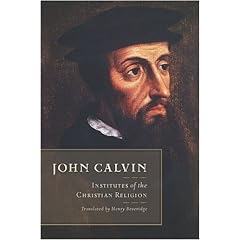
Institutes of the Christian Religion

Agree or disagree the Institutes are clear and that is, to me, refreshing.  As usual, I'll use this space to relay my highlights.  

From Chapter 1:
"we always seem to ourselves just, and upright, and wise, and holy, until we are convinced, by clear evidence, of our injustice, vileness, folly, and impurity. Convinced, however, we are not, if we look to ourselves only, and not to the Lord also -He being the only standard by the application of which this conviction can be produced. For, since we are all naturally prone to hypocrisy, any empty semblance of righteousness is quite enough to satisfy us instead of righteousness itself. And since nothing appears within us or around us that is not tainted with very great impurity, so long as week keep our mind within the confines of human pollution, anything which is in some small degree less defiled delights us as if it were most pure just as an eye, to which nothing but black had been previously presented, deems an object of a whitish, or even of a brownish hue, to be perfectly white...If, at mid-day, we either look down to the ground, or on the surrounding objects which lie open to our view, we think ourselves endued with a very strong and piercing eyesight; but when we look up to the sun, and gaze at it unveiled, the sight which did excellently well for the earth is instantly so dazzled and confounded by the refulgence, as to oblige us to confess that our acuteness in discerning terrestrial objects is mere dimness when applied to the sun. Thus, too, it happens in estimating our spiritual qualities. So long as we do not look beyond the earth, we are quite pleased with our own righteousness, wisdom and virtue...But should we once begin to raise our thoughts to God, and reflect what kind of being he is, and how absolute the perfection of that righteousness, and wisdom, and virtue, to which as a standard, we are bound to be conformed, what formerly delighted us by its false show of righteousness will become polluted with the greatest iniquity."

Monday, February 23, 2009

Paradise Lost: Book XII, LINES 469-478

After Michael, the archangel, explains to Adam how God will bring good through his sin, through a Savior for all mankind, Milton's Adam has this response:
"O goodness infinite, goodness immense!
That all this good of evil shall produce,
And evil turn to good; more wonderful
Than that which by creation first brought forth
Light out of darkness! Full of doubt I stand,
Whether I should repent me now of sin
By me done and occasioned, or rejoice
Much more, that much more good thereof shall spring,
To God more glory, more good will to men
From god, and over wrath grace shall abound."
-JOHN MILTON (1608-1674)

Saturday, February 14, 2009

Love II by George Herbert

Immortal Heat, O let thy greater flame
Attract the lesser to it: let those fires,
Which shall consume the world, first make it tame,
And kindle in our hearts such true desires,

As may consume our lusts, and make thee way.
Then shall our hearts pant thee; then shall our brain
All her intervention on thine Altar lay,
And there in hymns send back thy fire again.

Our eyes shall see thee, which before saw dust;
Dust blown by wit, till that they both were blind:
Thou shalt recover all thy goods in kind,
Who wert disseized by usurping lust:

All knees shall bow to thee, all wits shall rise,
And praise him who did make and mend our eyes.

Wednesday, February 11, 2009

Finally Alive


I realize it is shocking that I would be reading a book by John Piper, but this one has novel merit for me as a pastor.  The term "born again" has lost its weight and that loss has done violence to the Gospel leaving some to believe they have crossed over from death to life when they have not.  Consider the following quotes from the Introduction; 
"I'm not saying their [the Barna Group on the indistinguishable qualities of "born again" believers from their non-believing counterparts] research is wrong.  It appears to be appallingly right.  I am not saying that the church is not as worldly as they say it is.  I am saying that the writers of the New Testament think in exactly the opposite direction about being born again.  Instead of moving from a profession of faith to the label born again, to the worldliness of these so-called born again people, to the conclusion that the new birth does not radically change people, the New Testament moves in the other direction.

It moves from the absolute certainty that the new birth radically changes people, to the observation that many professing Christians are indeed not radically changed, to the conclusion that they are not born again." (see 1 John 2:29, 3:9, 4:7, 5:4 and 5:18)

...

"Jesus said to Nicodemus in John 3:7, "You must be born again." Not "I suggest it," or "Your life would improve if you added this experience."  Why is it that "unless one is born again he cannot see the kingdom of God" (John 3:3)?   This is one of the great reasons for pursuing a right knowledge of the new birth.  Until we realize that we must be born again, and why we must be born again, we probably will not realize what our condition really is without salvation."
Finally, a full review by Tim Challies

Wednesday, February 4, 2009

This Momentary Marriage (John Piper)


I'm discovering that I am lacking something as a husband.  I do not have an appreciation for God's intention in my marriage.  I could preach a decent sermon on the subject, but my heart still needs some work.  When I step outside of God's plan for me or when there is some disunity in my marriage, I want to feel what God feels and be grieved by something lost.
The romance in this book is not lacking but it is different.  It is directed Godward - painting a crystal clear picture of the glory of marriage for the glory of God.  "This..." will stir your heart to long for that experience where your relationship touches something eternal and finds a thrilling source of energy "till death do us part."  

Discussion Questions
I'll add these as they are developed:

CHAPTERS 1-3


Thursday, November 20, 2008

No Place for Truth


Excerpt from Chapter 1, "A Delicious Paradise Lost": 
pg. 46

"They (pre-industrial revolution Americans) had little that was new; we have little that has persisted.  This is true of things, relationships and values.  That was a tranquil world.  To be sure, they had their tragedies and sorrows, but they did not have the world's sorrow, from country after country, spilling nightly into their living rooms, their homes becoming places "where anguish comes by cable," to use W.H. Auden's words.  They were permanent residents.  We are nomads, perpetual immigrants, condemned to move from place to place in our own country until finally, if the sinews do not crack, we are allowed to pass into the forgetfulness of retirement.  Their needs were simple and related to survival; our needs are complex because our horizons are multiple and our possessions must serve many functions besides those related to survival.  They were attached to place, even if they had to move from the towns of their birth and settle elsewhere, and the had a sense of time; we have neither.  Their world was permanent because they new God to be unchanging; ours is impermanent and God seems largely to have disappeared.  Perhaps when our Wenham (Wenham, MA - the subject of this chapter, the "they" Wells refers to) townswoman became depressed she would have gone into the church to pray; her counterpart today would probably go to the mall to shop.  Therein lies the difference between these two worlds, worlds that are so close in time but so far apart mentally.

pg. 50
This is the experience without community.  It is the experience of mankind in the mass, bereft of the forces that once drew it into centers of human fraternity and organization.  From the impersonal mass, small groups fly off and fashion their own small worlds: the beatniks, the teddy boys, the skinheads, the molls, the hipsters, the inner-city gangs, the metalheads, the drugged-out offspring of an affluent age.  They are rebels, Christopher Lasch argues, whose cultural amnesia deprives them of the one thing they want most: the experience of being able to revolt.  In these ad hoc cultural protuberances there is nothing to revolt against; there is only the contemporary moment dislocated from the past and the future and stripped of parents, community, values and beliefs.  And yet these small worlds are so light, so weightless, that even the most fractured and fragile individual can feel safe and make connections, even if it is only with those who are equally fractured and fragile.  In these psychological environments, a fraternity of the wounded, the frightened, the bored, and the disoriented typically develops, and with it comes an illusion of therapy."

Thursday, November 13, 2008

Death By Love (Mark Driscoll)


A fantastic way to communicate the glory of some lofty-sounding doctrines like expiation, propitiation, etc.

The Christian Life: A Doctrinal Introduction (Sinclair Ferguson)


To call this "An Introduction..." is a little ridiculous. I'm hanging on here - trying to gird up the loins of my mind!

A great quote by J.C. Ryle in the 1st Chapter:
"He that wishes to attain right views about Christian holiness, must begin by examining the vast and solemn subject of sin. He must dig down very low if he would build high. A mistake here is most mischievous. Wrong views about holiness are generally traceable to wrong views about human corruption. I make no apology for beginning this volume of papers about holiness by make some plain statements about sin.

The plain truth is that a right knowledge of sin lies at the root of all saving Christianity. Without it such doctrines as justification, conversion, sanctification, are 'words and names' which convey no meaning to the mind. The first thing, therefore, that God does when he makes anyone a new creature in Christ, is to send light into his heart, and show him that he is a guilty sinner."
-from "Holiness"

Sunday, October 12, 2008

The Screwtape Letters


Chapter 15 (by C.S. Lewis):
My Dear Wormwood,
I had noticed, of course, that the humans were having a lull in their European war-what they naively call 'The War'! - and am not surprised that there is a corresponding lull in the patient's anxieties. Do we want to encourage this, or to keep him worried? Tortured fear and stupid confidence are both desirable states of mind. Our choice between them raises important questions.
The humans live in time but our Enemy destines them to eternity. He therefore, I believe, wants them to attend chiefly to two things, to eternity itself, and to that point of time which they call the Present. For the Present is the point at which time touches eternity. Of the present moment, and of it only, humans have an experience analogous to the experience which our Enemy has of reality as a whole; in it alone freedom and actuality are offered them. He would therefore have them continually concerned either with eternity (which means being concerned with Him) or with the Present - either meditating on their eternal union with, or separation from, Himself, or else obeying the present voice of conscience, bearing the present cross, receiving the present grace, giving thanks for the present pleasure.
Our business is to get them away from the eternal, and from the Present. With this in view, we sometimes tempt a human (say a widow or a scholar) to live in the Past. But this is of limited value, for they have some real knowledge of the past and it has a determinate nature and, to that extent, resembles eternity. It is far better to make them live in the Future. Biological necessity makes all their passions point in that direction already, so that thought about the Future inflames hope and fear. Also, it is unknown to them, so that in making them think about it we make them think of unrealities. In a word, the Future is, of all things, the least like eternity. It is the most completely temporal part of time - for the Past is frozen and no longer flows, and the Present is all lit up with eternal rays. Hence the encouragement we have given to all those schemes of thought such as Creative Evolution, Scientific Humanism, or Communism, which fix men's affections on the Future, on the very core of temporality. Hence nearly all vices are rooted in the future. Gratitude looks to the past and love to the present; fear, avarice, lust, and ambition look ahead.  Do not think lust an exception.   When the present pleasure arrives, the sin (which alone interests us) is already over.  The pleasure is just the part of the process which we regret and would exclude if we could do so without losing the sin; it is the part contributed by the Enemy, and therefore experienced in a Present.  The sin, which is our contribution, looked forward.
To be sure, the Enemy wants men to think of the Future too - just so much as is necessary for now planning the acts of justice or charity which will probably be their duty tomorrow.  The duty of planning the morrow's work is today's duty; though its material is borrowed from the future, the duty, like all duties, is in the Present.  This is now straw splitting.  He does nto want men to give the Future their hearts, to place their treasure in it.  We do.  His ideal is a man who, having worked all day for the good of posterity (if that is his vocation), washes his mind of the whole subject, commits the issue to Heaven, and returns at once to the patience or gratitude demanded by the moment that is passing over him.  But we want a man hagridden by the Future - haunted by visions of an imminent heaven or hell upon earth - ready to break the Enemy's commands in the Present if by so doing we make him think he can attain the one or avert the other dependent for his faith on the success of failure of schemes whose end he will not live to see.  We want a whole race perpetually in pursuit of the rainbow's end, never honest, nor kind, nor happy now, but always using as mere fuel wherewith to heap the altar of the Future every real gift which is offered them in the Present.
It follows then, then, in general, and other things being equal, that it is better for your patient to be filled with anxiety or hope (it doesn't much matter which) about this war than for him to be living in the Present.  But the phrase "living in the Present" is ambiguous.  It may describe a process which is really just as much concerned with the Future as anxiety itself.  Your man may be untroubled about the Future, not because he is concerned with the Present, but because he has persuaded himself that the Future is going to be agreeable.  As long as that is the real course of his tranquility, his tranquility will do us good, because it is only piling up more disappointment, and therefore more impatience, for him when his false hopes are dashed.  If, on the other hand, he is aware that horrors may be in store for him and is praying for the virtues wherewith to meet them, and meanwhile concerning himself with the Present because there, and there alone, all duty, all grace, all knowledge, and all pleasure dwell, his state is very undesirable and should be attacked at once.  Here again, our Philological Arm has done good work; try the word "complacency" on him.  But, of course, it is most likely that he is "living in the Present" for none of these reasons but simply because his health is good and he is enjoying his work.  The phenomenon would then be merely natural.  All the same, I should break it up if I were you.  No natural phenomenon is really in our favour.  And anyway, why should the creature be happy?
Your affectionate uncle
SCREWTAPE