Showing posts with label Doctrine. Show all posts

Tuesday, August 18, 2009

The Glory of Christ by John Owen

In typical Puritan fashion, The Glory of Christ by John Owen is a bold statement that spiritual life without Christ is really no spiritual life at all. If your soul feels dry and lacks any substantial joy - grab this little book (which is anything but little in content) and meditate on the greatness of God our Savior.

Quote from the book:
"A constant view of the glory of Christ will revive our souls and cause our spiritual lives to flourish and thrive. Our souls will be revived by the transforming power with which beholding Christ is always accompanied. This is what transforms us daily into the likeness of Christ. So let us live in constant contemplation of the glory of Chirst, and power will then flow from him to us, healing all our declensions, renewing a right spirit in us and enabling us to abound in all the duties that God requires of us.

Faith will fix our souls in Christ who will fill us with delight and satisfaction. This then, in heaven, is perfect blessedness, for it is caused by the eternal vision of the glory of God in Christ. So the more we behold the glory of Christ by faith now, the more spiritual and the more heavenly will be the state of our souls.

The reason why the spiritual life is our souls decays and withers is because we fill our minds full of other things, and these things weaken the power of grace. But when the mind is filled with thoughts of Christ and his glory, these things will be expelled (see Col. 3:1-5, Eph. 5:8)

Additional Resources
Discussion Questions for a 7-week discussion on the book (1, 2, 3, 4, 5, 6, and 7)

Friday, April 10, 2009

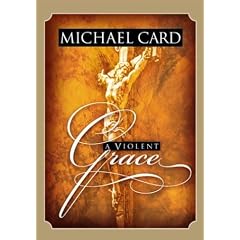
A Violent Grace by Michael Card

by canceling the record of debt that stood against us with its legal demands. This he set aside, nailing it to the cross. (Colossians 2.14)

For in him all the fullness of God was pleased to dwell, and through him to reconcile to himself all things, whether on earth or in heaven, making peace by the blood of his cross. (Colossians 1.19-20)


From Chapter 10 "He Was Nailed to the Cross So I Might Escape Judgment"
The mock trials are over.  The little that Pilate was willing to do to release Jesus, he has done. Now, for the record, he publicly washes his hands of the matter, as if the water could cleanse him of his responsibility. And then he utters the formal sentence: "Ab in crucem." You shall mount the cross. 

Four soldiers carry out Jesus' execution. Although as many as six hundred men were sent to arrest Jesus, Pilate now sees little chance of a riot. Of all Jesus' supporters, only weeping women are left.

Two soldiers lift the forty-pound crossbeam onto Jesus' shoulders. He is going to carry His own cross to the place of execution.  
...
Step by excruciating step, Jesus stumbles out of the Praetorium and down the twisted streets of the city, a great throng following.  How far does He stagger before He falls face down and lies skinned and bruised beneath the beam?

Some onlookers turn their eyes from His agony. Others watch disinterestedly while they hawk their wares, waiting for the mob to thin so they can carry on the real business of the day. Most cheer or curse as Jesus struggles to rise, takes another step, and stumbles past.

Soon he falls again. What makes Him crumple? Is it the weight of the crossbeam added to His wounds and loss of blood from the scourging? Is it the incalculable burden of the whole world's rebellion? Is it the weight of all our sorrows that presses Him down? It is all those things, and at last the weight grinds God's Son into the stones and stops the procession.
...
The crowd forms a tight, expectant circle around the site of the execution. Some spectators suddenly fall silent, and perhaps for the first time the wailing of the women can be heard.
...
Now three soldiers stretch out Jesus out upon the crossbeam while the other picks up an iron spike. The nail is a tapered shaft from five to seven inches long and about three-eights of an inch across.
The fourth soldier swings his mallet high. The women turn away. The mallet falls, pounding the spike through Jesus' flesh and deep into the wound. Seconds later, the second spike is pounded home. Now Jesus is impaled on the crossbeam.

The soldiers hoist up the beam on which Jesus hangs bleeding and fasten it to the upright timber. With the crossbeam in place, the soldiers grasp Jesus' feet and place them one on top of the other. Next they hold a piece of wood over His crossed feet and drive a single spike through it through His heel bones, and into the wood of the cross.

The sentence for Jesus has been carried out...All that lies ahead for Jesus is agony and waiting.

Crucifixion was death by exhaustion - every minute consumed with the painful necessity of struggling to suck another breath. In fact, medical experts tell us that David's cry in Psalm 69 is a physiologically accurate description of Jesus' experience of dying. "Save me, O God, for the waters have come up to my neck. I sink in the miry depths, where there is no foothold" (vv. 1-2).

The legacy of death by crucifixion is still with us in the word "excruciating," which literally means "out of the cross." To extend the life-and thus the torment-of the victim, the executioners took care not to damage his vital organs. If they performed everything properly, he could hang for as long as nine days before death came.

If they had flogged the victim repeatedly beforehand, however, he could die sooner from loss of blood. This could help explain the unusual fact that Jesus died on the same day as He was crucified.

Thursday, March 5, 2009

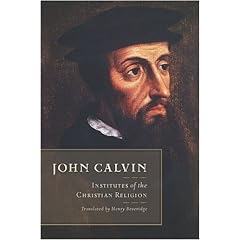
Institutes of the Christian Religion

Agree or disagree the Institutes are clear and that is, to me, refreshing.  As usual, I'll use this space to relay my highlights.  

From Chapter 1:
"we always seem to ourselves just, and upright, and wise, and holy, until we are convinced, by clear evidence, of our injustice, vileness, folly, and impurity. Convinced, however, we are not, if we look to ourselves only, and not to the Lord also -He being the only standard by the application of which this conviction can be produced. For, since we are all naturally prone to hypocrisy, any empty semblance of righteousness is quite enough to satisfy us instead of righteousness itself. And since nothing appears within us or around us that is not tainted with very great impurity, so long as week keep our mind within the confines of human pollution, anything which is in some small degree less defiled delights us as if it were most pure just as an eye, to which nothing but black had been previously presented, deems an object of a whitish, or even of a brownish hue, to be perfectly white...If, at mid-day, we either look down to the ground, or on the surrounding objects which lie open to our view, we think ourselves endued with a very strong and piercing eyesight; but when we look up to the sun, and gaze at it unveiled, the sight which did excellently well for the earth is instantly so dazzled and confounded by the refulgence, as to oblige us to confess that our acuteness in discerning terrestrial objects is mere dimness when applied to the sun. Thus, too, it happens in estimating our spiritual qualities. So long as we do not look beyond the earth, we are quite pleased with our own righteousness, wisdom and virtue...But should we once begin to raise our thoughts to God, and reflect what kind of being he is, and how absolute the perfection of that righteousness, and wisdom, and virtue, to which as a standard, we are bound to be conformed, what formerly delighted us by its false show of righteousness will become polluted with the greatest iniquity."

Wednesday, February 11, 2009

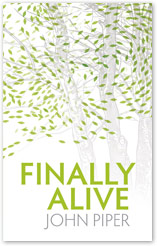
Finally Alive


I realize it is shocking that I would be reading a book by John Piper, but this one has novel merit for me as a pastor.  The term "born again" has lost its weight and that loss has done violence to the Gospel leaving some to believe they have crossed over from death to life when they have not.  Consider the following quotes from the Introduction; 
"I'm not saying their [the Barna Group on the indistinguishable qualities of "born again" believers from their non-believing counterparts] research is wrong.  It appears to be appallingly right.  I am not saying that the church is not as worldly as they say it is.  I am saying that the writers of the New Testament think in exactly the opposite direction about being born again.  Instead of moving from a profession of faith to the label born again, to the worldliness of these so-called born again people, to the conclusion that the new birth does not radically change people, the New Testament moves in the other direction.

It moves from the absolute certainty that the new birth radically changes people, to the observation that many professing Christians are indeed not radically changed, to the conclusion that they are not born again." (see 1 John 2:29, 3:9, 4:7, 5:4 and 5:18)

...

"Jesus said to Nicodemus in John 3:7, "You must be born again." Not "I suggest it," or "Your life would improve if you added this experience."  Why is it that "unless one is born again he cannot see the kingdom of God" (John 3:3)?   This is one of the great reasons for pursuing a right knowledge of the new birth.  Until we realize that we must be born again, and why we must be born again, we probably will not realize what our condition really is without salvation."
Finally, a full review by Tim Challies

Thursday, November 13, 2008

Death By Love (Mark Driscoll)


A fantastic way to communicate the glory of some lofty-sounding doctrines like expiation, propitiation, etc.

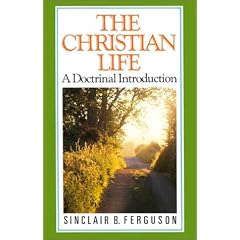
The Christian Life: A Doctrinal Introduction (Sinclair Ferguson)


To call this "An Introduction..." is a little ridiculous. I'm hanging on here - trying to gird up the loins of my mind!

A great quote by J.C. Ryle in the 1st Chapter:
"He that wishes to attain right views about Christian holiness, must begin by examining the vast and solemn subject of sin. He must dig down very low if he would build high. A mistake here is most mischievous. Wrong views about holiness are generally traceable to wrong views about human corruption. I make no apology for beginning this volume of papers about holiness by make some plain statements about sin.

The plain truth is that a right knowledge of sin lies at the root of all saving Christianity. Without it such doctrines as justification, conversion, sanctification, are 'words and names' which convey no meaning to the mind. The first thing, therefore, that God does when he makes anyone a new creature in Christ, is to send light into his heart, and show him that he is a guilty sinner."
-from "Holiness"