Saturday, April 4, 2009

A Bruised Reed Shall He Not Break -Christina Rossetti (1830-1894)

I will accept they will to do and be,
Thy hatred and intolerance of sin,
Thy will at least to love, that burns within
And thirsteth after Me:
So I will render fruitful, blessing still
The germs and small beginnings in thy heart,
Because thy will cleaves to the better part, -
Alas, I cannot will.

Dost not thou will, pour soul? Yet I receive
The inner unseen longings of the soul,
I guide them turning towards Me; I control
And charm hearts till they grieve:
If thou desire, it yet shall come to pass,
Tho' thou but wish indeed to choose My love;
For I have power in earth and heaven above. - 
I cannot wish, alas!

What, neither choose nor wish to choose? and yet
I still must strive to win thee and constrain:
For thee I hung upon the cross in pain,
How then can I forget?
If thou as yet dost neither love, nor hate,
Nor choose, nor wish, - resign thyself, be still
Till I infuse love, hatred, longing, will. -
I do not deprecate.
-Christina Rossetti (1830-1894)
This was to fulfill what was spoken by the prophet Isaiah: “Behold, my servant whom I have chosen, my beloved with whom my soul is well pleased. I will put my Spirit upon him, and he will proclaim justice to the Gentiles. He will not quarrel or cry aloud, nor will anyone hear his voice in the streets; a bruised reed he will not break, and a smoldering wick he will not quench, until he brings justice to victory;
(Matthew 12.17-20 ESV)

Thursday, March 5, 2009

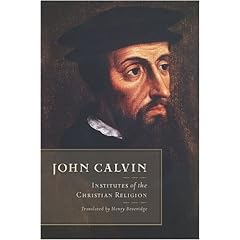
Institutes of the Christian Religion

Agree or disagree the Institutes are clear and that is, to me, refreshing.  As usual, I'll use this space to relay my highlights.  

From Chapter 1:
"we always seem to ourselves just, and upright, and wise, and holy, until we are convinced, by clear evidence, of our injustice, vileness, folly, and impurity. Convinced, however, we are not, if we look to ourselves only, and not to the Lord also -He being the only standard by the application of which this conviction can be produced. For, since we are all naturally prone to hypocrisy, any empty semblance of righteousness is quite enough to satisfy us instead of righteousness itself. And since nothing appears within us or around us that is not tainted with very great impurity, so long as week keep our mind within the confines of human pollution, anything which is in some small degree less defiled delights us as if it were most pure just as an eye, to which nothing but black had been previously presented, deems an object of a whitish, or even of a brownish hue, to be perfectly white...If, at mid-day, we either look down to the ground, or on the surrounding objects which lie open to our view, we think ourselves endued with a very strong and piercing eyesight; but when we look up to the sun, and gaze at it unveiled, the sight which did excellently well for the earth is instantly so dazzled and confounded by the refulgence, as to oblige us to confess that our acuteness in discerning terrestrial objects is mere dimness when applied to the sun. Thus, too, it happens in estimating our spiritual qualities. So long as we do not look beyond the earth, we are quite pleased with our own righteousness, wisdom and virtue...But should we once begin to raise our thoughts to God, and reflect what kind of being he is, and how absolute the perfection of that righteousness, and wisdom, and virtue, to which as a standard, we are bound to be conformed, what formerly delighted us by its false show of righteousness will become polluted with the greatest iniquity."